Train/Test Split and the Confusion Matrix: Grading a Classifier Honestly
Part 4 of 9 in Machine Learning from Scratch · course bundle (code + data)
What you'll build
Take tutorial 71's home-win logistic regression, hold out 25% of games the model never sees, and grade it on those - then go past accuracy to the confusion matrix, precision, and recall.
In the logistic-regression tutorial we trained a classifier to predict the NBA home win and reported that it was right 67% of the time. But we graded it on the same games it learned from — an open-book exam where the model had already seen every answer. The honest question is how it does on games it has never seen. That's what a train/test split answers, and the confusion matrix tells you what kind of mistakes it makes when a single accuracy number won't.
We reuse tutorial 71's setup exactly — predict the home win from the net-rating gap — on the bundled nba_ratings.csv and nba_home_results.csv, in pure numpy, offline.
Further reading: Chapter 29: Evaluating Models — Accuracy, Precision, Recall, DataField.dev.
-
Hold out a test set the model never sees
Shuffle the games with a fixed seed (so the tutorial is reproducible) and slice off 75% to train on and 25% to test on. The model will learn from the training games only; the test games are locked in a drawer until grading time.
python import numpy as np, pandas as pd # ... build x_all (net-rating gap, standardized) and y_all (home win) as in tutorial 71 ... rng = np.random.default_rng(72) idx = rng.permutation(len(x_all)) cut = int(0.75 * len(x_all)) tr, te = idx[:cut], idx[cut:] # train indices, test indices x_tr, y_tr = x_all[tr], y_all[tr] x_te, y_te = x_all[te], y_all[te]The splitTotal games: 1231 Train: 923 Test (held out): 308 Home-win rate -> train 54.9% | test 52.6%
Roughly 920 games to learn from, 300 held out. The home-win rate is about the same in both halves — a quick sanity check that the random split didn't accidentally hand us a lopsided test set.
-
Train on the training set only
Exactly the gradient descent from tutorial 71 — but it only ever touches
x_trandy_tr. The test games are invisible to it.python def sigmoid(z): return 1.0 / (1.0 + np.exp(-z)) w, b, lr = 0.0, 0.0, 0.3 for _ in range(400): p = sigmoid(w * x_tr + b) err = p - y_tr w -= lr * np.mean(err * x_tr) b -= lr * np.mean(err)That's the whole training step. Now — and only now — do we open the drawer.
-
Grade it honestly
Score the model on both halves. The number that matters is the test accuracy: performance on games it never trained on.
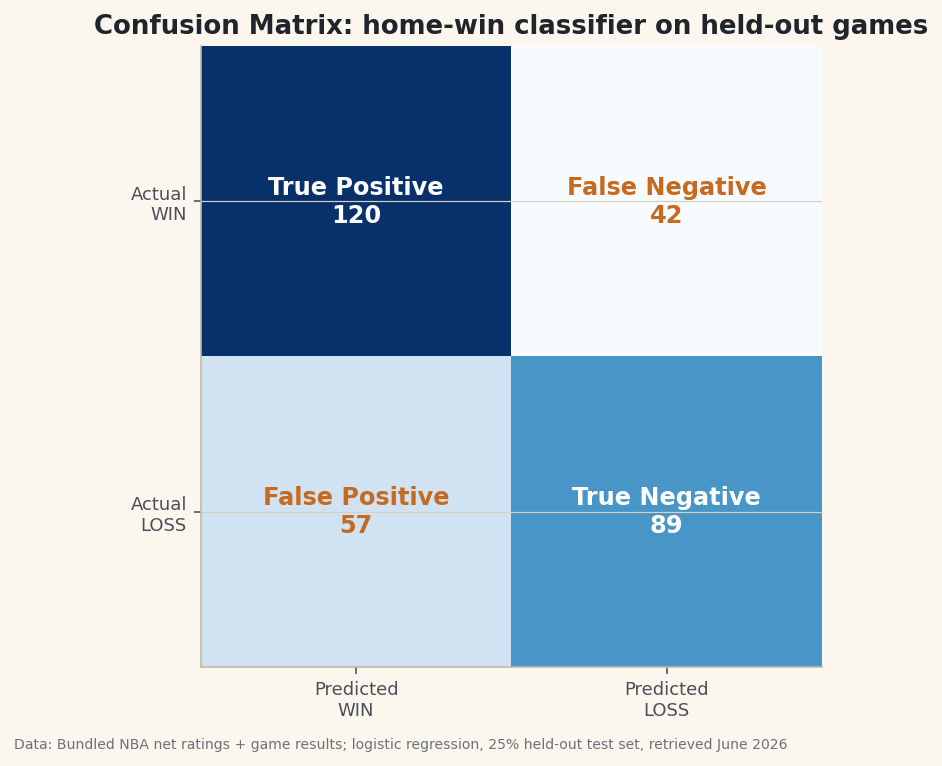
python acc_tr = ((sigmoid(w*x_tr + b) >= 0.5) == y_tr).mean() acc_te = ((sigmoid(w*x_te + b) >= 0.5) == y_te).mean()Honest evaluationAccuracy on TRAIN games: 67.5% Accuracy on TEST games: 67.9% <- the honest number Confusion matrix (test set, positive = home win): pred WIN pred LOSS actual WIN 120 42 actual LOSS 57 89 Precision (of predicted wins, how many were right): 67.8% Recall (of real wins, how many we caught): 74.1% F1 score: 0.708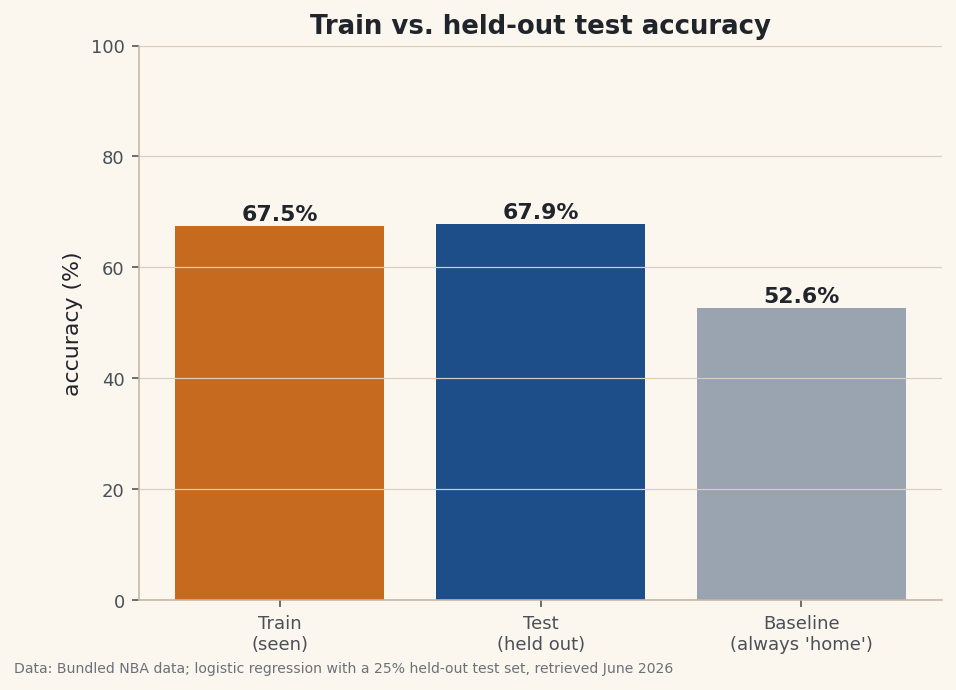
Data: Bundled Basketball-Reference net ratings + 1,231 game results, 25% held-out test split, retrieved June 2026 Train and test accuracy are almost identical (about 67.5% vs 67.9%). That's the signature of a model that generalizes: it learned a real pattern, not the noise of specific games. A model that scored 90% on training and 60% on test would be overfitting — memorizing instead of learning. Our two-parameter model is too simple to overfit, which is a feature here. Both clear the “always pick home” baseline of about 53%.
-
Past accuracy: the confusion matrix
Accuracy hides what kind of mistakes a model makes. The confusion matrix splits every test prediction into four boxes — correct wins (true positives), correct losses (true negatives), and the two ways to be wrong.
python pred = (sigmoid(w*x_te + b) >= 0.5).astype(int) tp = int(np.sum((pred==1) & (y_te==1))) # said WIN, was WIN fp = int(np.sum((pred==1) & (y_te==0))) # said WIN, was LOSS fn = int(np.sum((pred==0) & (y_te==1))) # said LOSS, was WIN tn = int(np.sum((pred==0) & (y_te==0))) # said LOSS, was LOSSData: Bundled Basketball-Reference net ratings + 1,231 game results, 25% held-out test split, retrieved June 2026 Read the diagonal (120 + 89 correct) against the off-diagonal (57 + 42 wrong). Notice the model leans toward predicting “home win” — it has more false positives (57) than false negatives (42), because home teams win more often, so guessing “home” is the safer bet.
-
Precision, recall, and F1
The four boxes give you the metrics accuracy can't. Precision: when the model says “home win,” how often is it right? Recall: of all the actual home wins, how many did it catch? F1 blends the two.
python precision = tp / (tp + fp) # of predicted wins, share correct recall = tp / (tp + fn) # of real wins, share caught f1 = 2*precision*recall / (precision + recall)Here precision is about 68% and recall about 74% — the model catches three-quarters of real home wins but pays for it with some false alarms. That precision/recall trade is invisible in the single accuracy number, and it's exactly what you'd tune (by moving the 0.5 threshold) if false alarms cost more than misses, or vice versa.
Troubleshooting
My test accuracy is much lower than train
That's overfitting — the model memorized the training set. It happens with flexible models (many features, deep trees) on small data. Fixes: simpler model, fewer features, regularization, or more data. Our two-parameter logistic model is too simple to overfit, which is why train and test match here.
My test score changes every run
You're not seeding the shuffle, so the split changes each time. Use a fixed seed (np.random.default_rng(72)) for a reproducible split. On small test sets the score will still wobble a few points across different seeds — that wobble is real uncertainty; for a tighter estimate use k-fold cross-validation.
Why not just report accuracy?
Accuracy lies when classes are imbalanced. If 90% of games were home wins, “always predict home” scores 90% while being useless. Precision and recall expose that; always check them, and compare against the majority-class baseline.
Challenge yourself
Move the decision threshold off 0.5 (say to 0.6) and watch precision rise while recall falls — then plot the trade-off as a precision-recall curve. Next, replace the single split with 5-fold cross-validation (train five times, each time holding out a different fifth) and average the scores for a more stable estimate. Finally, add a second feature from tutorial 71 and check whether test accuracy actually improves — or whether you've started to overfit.
Get the code
Want it all in one file? This is the finished script behind this tutorial - the run that produced the outputs above.
Download the finished script (72_train_test_split_confusion_matrix.py)This script imports a small shared helper (and reads any bundled sample data) that live next to it in /downloads/ — grab these into the same folder so it runs as-is: sdt_common.py, sdt_nba.py. Or skip the collecting: the Machine Learning from Scratch bundle has this whole course’s scripts and data in one ZIP.