Same Question, Five Sports: Quantifying Home Advantage Across Leagues
Part 5 of 5 in Hockey & Cross-League Projects · course bundle (code + data)
What you'll build
One chart comparing home-win rate across MLB, NBA, soccer, the NFL, and the NHL.
This is the capstone, and it's the tutorial I'm proudest of, because it does the thing the whole site is secretly about: taking five separate skills you learned in isolation and pointing all of them at one question at the same time. The question is the oldest argument in any sports bar - how big is home advantage, really? Everybody has a feeling about it; almost nobody has a number. We'll get the number the honest way - the share of games actually won by the home team - across five leagues at once: MLB, the NBA, the Premier League, the NFL, and the NHL, all on one chart, caveats and all. And the answer is more interesting than "home teams win more," I promise.
Further reading: Comparing Two Groups, DataField.dev.
What makes this a capstone isn't any one technique - it's that you'll reuse every data-access pattern the site taught, side by side in one script: a polite API session hitting two different sports endpoints, the nflverse parquet helper, a CSV read straight off the web, and a bundled fallback for the one source that blocks automated servers. It draws together the Statcast leaderboard, EPA explained by building it, and the NHL shot-location plot. If you've done those, you've already done the hard parts - today is about composition.
-
One question, five data sources
The trick to a project like this is to give each league its own small function that returns the same shape: a home-win rate, a game count, and a season label. Once every source conforms to that contract, the rest of the program treats all five identically - even though each league forces a different access method.
python import io import os import matplotlib.pyplot as plt import pandas as pd import sdt_common as sdt import sdt_nflverse as nfl sdt.init("quantifying-home-advantage-across-five-leagues") HERE = os.path.dirname(os.path.abspath(__file__)) session = sdt.polite_session()That single
polite_session()- a requests session with real browser headers and automatic retry with backoff - is the same well-behaved client we've used for every live API on the site. We'll share it across the MLB, NHL, and soccer pulls. -
MLB and NHL: two live APIs, one session
Baseball and hockey both publish official standings that already carry each team's home record, so we never need to scan individual games. For MLB we read the Stats API standings and dig into each team's
splitRecordsfor the "home" split. For the NHL we read the standings and sum the home wins, losses, and overtime losses across all teams.python def mlb_home(): # MLB Stats API standings carry each team's home W-L split r = session.get("https://statsapi.mlb.com/api/v1/standings", params={"leagueId": "103,104", "season": "2023", "standingsTypes": "regularSeason"}, timeout=30).json() hw = hl = 0 for grp in r["records"]: for tr in grp["teamRecords"]: for s in tr["records"]["splitRecords"]: if s["type"] == "home": hw += s["wins"]; hl += s["losses"] return hw / (hw + hl), hw + hl, "2023" def nhl_home(): # NHL standings carry home wins / losses / OT losses teams = session.get("https://api-web.nhle.com/v1/standings/now", timeout=30).json()["standings"] hw = sum(t["homeWins"] for t in teams) hl = sum(t["homeLosses"] for t in teams) ho = sum(t["homeOtLosses"] for t in teams) return hw / (hw + hl + ho), hw + hl + ho, "2024-25"Notice the small honesty in
nhl_home: hockey has no ties, but it does have overtime/shootout losses, so the denominator is wins plus regulation losses plus OT losses. Get that wrong and the rate is subtly inflated. This is the same NHL API you met in the shot-location tutorial, just asking it a season-level question instead of a play-level one. -
NFL: the nflverse helper, counting games
For football we reuse the exact helper from the NFL tutorials. nflverse's schedule file has the final score of every game, so the home-win rate is just a comparison we average over all regular-season games.
python def nfl_home(): # nflverse schedules have the score of every game s = nfl.import_schedules([2023]) g = s[(s["game_type"] == "REG")].dropna(subset=["home_score", "away_score"]) return (g["home_score"] > g["away_score"]).mean(), len(g), "2023"The pattern
(g["home_score"] > g["away_score"]).mean()is worth committing to memory: a comparison produces a column ofTrue/False, and the mean of booleans is the fraction that areTrue- here, the home-win rate, in one line. Because we usesdt_nflverse, this works on a modern pandas; the realnfl_data_pywould crash with theDataFrame.append()error covered in the EPA tutorial and its siblings. -
Soccer: a CSV straight off the web
The Premier League comes from football-data.co.uk, which publishes every season as a plain CSV. We download the bytes and read them directly into pandas without ever touching disk. The column we want is
FTR- full-time result - codedH,D, orAfor home win, draw, or away win.python def soccer_home(): # football-data.co.uk: FTR = full-time result (H/D/A) raw = session.get("https://www.football-data.co.uk/mmz4281/2324/E0.csv", timeout=30).content df = pd.read_csv(io.BytesIO(raw)).dropna(subset=["FTR"]) return (df["FTR"] == "H").mean(), len(df), "2023-24 EPL"Wrapping the downloaded bytes in
io.BytesIOletspd.read_csvtreat them like a file - a tidy way to read a remote CSV in memory. Keep thatFTR == "H"line in mind: it counts only home wins, and as we'll see, that "only" matters enormously for soccer. -
NBA: an honest bundled fallback
The NBA is the asterisk. Its stats endpoint,
stats.nba.com, blocks automated build servers outright, so a live pull would simply fail when this site rebuilds. Rather than fake it or skip basketball, we bundle a CSV of the season's real game results and read that instead - clearly labeled so nobody mistakes it for a live figure.python def nba_home(): # stats.nba.com blocks our build server, so we use the bundled real results d = pd.read_csv(os.path.join(HERE, "nba_home_results.csv")) return (d["home_pts"] > d["away_pts"]).mean(), len(d), "2023-24 (bundled)"This is a real lesson, not a cop-out. Sometimes the only thing that keeps an automated pipeline reliable is to cache real data and be transparent about it. The numbers are genuine 2023-24 results; only the delivery is local, and the "(bundled)" tag rides along to the final table so the provenance is never lost.
-
Assemble and rank the five leagues
With five functions that all return the same triple, the orchestration is trivial. We map each league to its sport color and its function, call them in a loop, and build one DataFrame sorted by home-win rate.
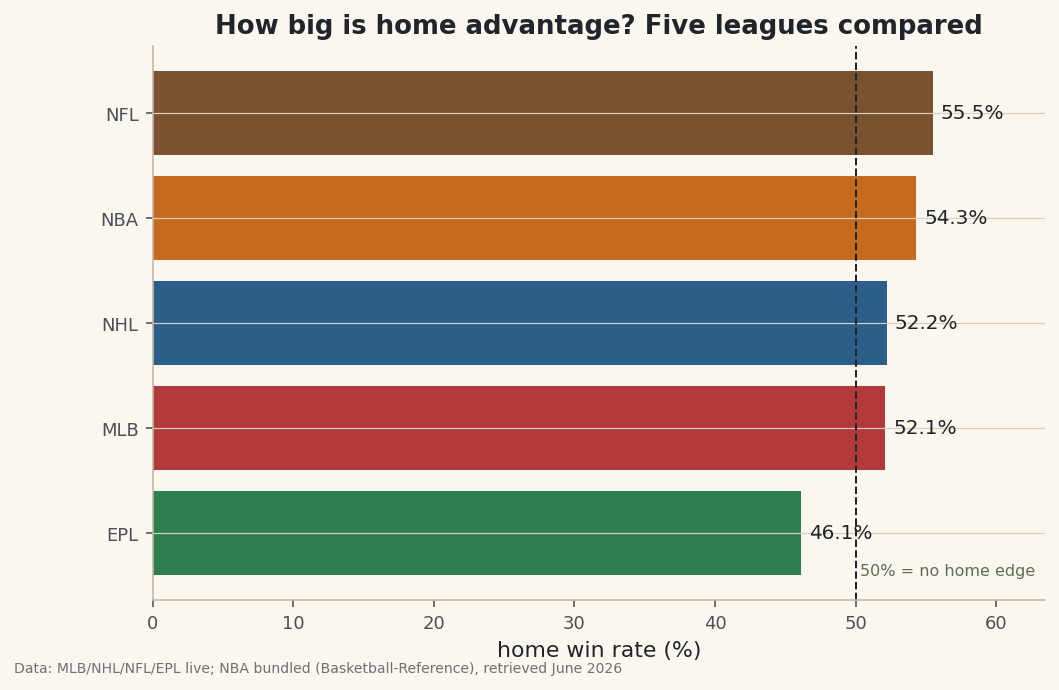
python leagues = {"MLB": ("baseball", mlb_home), "NBA": ("basketball", nba_home), "EPL": ("soccer", soccer_home), "NFL": ("football", nfl_home), "NHL": ("hockey", nhl_home)} rows = [] for name, (sport, fn) in leagues.items(): pct, n, season = fn() rows.append({"League": name, "sport": sport, "HomeWin%": round(pct * 100, 1), "Games": n, "Season": season}) table = pd.DataFrame(rows).sort_values("HomeWin%", ascending=False).reset_index(drop=True) with sdt.snippet("table"): show = table.copy() show.index = range(1, len(show) + 1) print("Share of games won by the home team:") print(show.to_string())Home-win rate across five leaguesShare of games won by the home team: League sport HomeWin% Games Season 1 NFL football 55.5 272 2023 2 NBA basketball 54.3 1231 2023-24 (bundled) 3 NHL hockey 52.2 1312 2024-25 4 MLB baseball 52.1 2430 2023 5 EPL soccer 46.1 380 2023-24 EPL
There's the answer, ranked. The NFL has the biggest home edge - the home team won 55.5% of 272 games in 2023. The NBA is close behind at 54.3%, then the NHL at 52.2% and MLB at 52.1%, both barely above an even split. And the Premier League sits dead last at 46.1%. One honesty note about the Season column: the five rows do not cover one aligned season. This table is a dated snapshot - each function reports whatever season its source served (or was pinned to) when the data was retrieved in June 2026: MLB and the NFL are 2023, the EPL is 2023-24, the NBA is the bundled 2023-24 results, and the NHL row is 2024-25 as labeled by its standings feed. That's why the script makes every function return its own season label and game count instead of assuming them - the label rides along to the table, so the mismatch is visible rather than hidden. (The NBA's 1,231 games are the 1,230-game regular season plus the In-Season Tournament final, which the bundled file includes.)
-
Chart it - and read it honestly
A horizontal bar chart, colored by sport, with a dashed line at 50% to mark "no home edge at all," tells the story instantly. Anything left of that line means the home team won less than half its games.
python plot_df = table.sort_values("HomeWin%") colors = [sdt.SPORT_COLORS[s] for s in plot_df["sport"]] fig, ax = plt.subplots(figsize=(8, 5)) bars = ax.barh(plot_df["League"], plot_df["HomeWin%"], color=colors) ax.bar_label(bars, fmt="%.1f%%", padding=4, fontsize=10) ax.axvline(50, color="#20242B", linestyle="--", linewidth=1) ax.text(50.3, -0.4, "50% = no home edge", fontsize=8, color=sdt.SPORT_COLORS["foundations"]) ax.set_xlim(0, max(plot_df["HomeWin%"]) + 8) ax.set_xlabel("home win rate (%)") ax.set_title("How big is home advantage? Five leagues compared") sdt.save_fig(fig, "home_advantage", source="MLB/NHL/NFL/EPL live; NBA bundled (Basketball-Reference)")Data: MLB, soccer, NHL, NFL (live) + NBA (bundled sample), retrieved June 2026; season labels as returned by each source Now the crucial caveat, because a naive reading of this chart is wrong. The Premier League's 46.1% looks like soccer teams are worse at home - but that's an artifact of how we defined the metric. We counted home wins only, and soccer is the one sport here where a game can end in a draw. Roughly one in four EPL matches is a tie, and a draw isn't a home win, so it drags the rate down even when the home side genuinely held an edge. The other four leagues effectively have no draws, so nearly every game is forced into a win for somebody. We're not comparing five identical quantities; soccer's denominator includes a third outcome the others lack.
Read correctly, the honest takeaways are: home advantage is real and positive in the four leagues that can't end in a draw, it's largest in the NFL, and the EPL's low win rate is mostly a draw effect rather than evidence that home soccer teams are disadvantaged. That distinction - between what a number literally measures and what it appears to say - is the most important habit in all of sports analytics, and a fitting note to end the site on.
Troubleshooting
The NBA pull fails or stats.nba.com times out
Expected - that endpoint blocks automated and data-center traffic, which is exactly why this tutorial ships a bundled CSV of real results instead. Use the included nba_home_results.csv as the script does. If you're on a normal home connection and want to pull it live yourself, you'll need the nba_api package and a real browser-like session; even then it's unreliable from cloud servers.
AttributeError: 'DataFrame' object has no attribute 'append' on the NFL step
You imported the real nfl_data_py on a modern pandas. It still calls the removed DataFrame.append(). This capstone uses the sdt_nflverse helper precisely to avoid that. Either keep using the helper, or build a separate venv pinned to pandas<2.0 / numpy<2.0 before installing the library.
KeyError: 'splitRecords' or 'FTR'
An upstream source changed its shape, or you hit the wrong season's URL. For MLB, confirm the standings response actually contains records → teamRecords → records → splitRecords by printing one team before looping. For soccer, football-data.co.uk's column set is stable but check that you downloaded the right division code (E0.csv is the Premier League) and that the CSV isn't an error page - print df.columns to verify.
A request hangs or returns a 429/503
That's why we route everything through polite_session() - it retries the flaky status codes with exponential backoff automatically. If a single source is genuinely down, comment out that league's function temporarily; because each one is self-contained, the other four still produce a valid (smaller) chart.
Challenge yourself
Make the soccer comparison fair. Instead of a home-win rate, compute home points per game for the EPL using its actual scoring - 3 for a win, 1 for a draw, 0 for a loss - and compare it to the away points per game in the same season. A home points-per-game clearly above the away figure reveals the home edge that the raw win rate hid behind all those draws. For a tougher extension, recompute every league as home points-per-game under its own rules and re-rank: does the NFL still lead once draws are handled honestly? You'll have built a genuinely apples-to-apples cross-sport comparison - the capstone of the capstone.
Take the script home
The finished script behind this tutorial is the one that was run to produce its figures and printouts; download it and run it yourself.
Download the finished script (20_quantifying_home_advantage_across_five_leagues.py)This script imports a small shared helper (and reads any bundled sample data) that live next to it in /downloads/ — grab these into the same folder so it runs as-is: sdt_common.py, sdt_nflverse.py, nba_home_results.csv. Or skip the collecting: the Hockey & Cross-League Projects bundle has this whole course’s scripts and data in one ZIP.